The Automations Page
The Automations page is the single home for the whole feature. It has its own icon on the rail, and its five sections are listed under Automations in that menu. Select a section there to open it:
Written By Christopher Scaminaci
Last updated 17 days ago
The Automations page is the single home for the whole feature. It has its own icon on the rail, and its five sections are listed under Automations in that menu. Select a section there to open it:
You can deep-link to any section — the selected section is mirrored into the URL (for example /automations?tab=templates), so bookmarks and shared links open the right section. Older links to /credits and /automations/templates redirect here automatically.
If you have an Agent Runner plan but no Anthropic key
One alert is page-scoped rather than belonging to any section: it sits above the section's content in every section. It appears only for an organization that holds an active Agent Runner plan and has no Anthropic key on file, and it reads:
Enroll your Anthropic key to activate your flat-fee plan
Your Agent Runner plan is active, but runs are still billing credits because your organization has no Anthropic key on file. Add one and your runs bill Anthropic directly instead.
It links to Add your Anthropic key, which opens the Credits section. Nothing is blocked while it is showing — that is the substance of it: an Agent Runner plan with no key still runs on StackJack credits. It is a reminder that you are not yet getting what the plan is for. Everyone else sees nothing here, and so does anyone whose plan or key status could not be read.
After your Anthropic key changes
A second page-scoped alert appears after your organization's own Anthropic key is added or replaced (in the Credits section), while you have at least one provisioned automation:
Re-sync your automations
Your Anthropic key changed. Re-sync all automations so they run on the new key.
Its Re-sync all button opens the same dialog as Re-sync all in the Automations section (see Re-sync all). A key from a different Anthropic organization cannot reach the automations created with the old key, so until they are re-synced their runs fail. StackJack never re-syncs them for you. The alert goes away after a Re-sync all that re-syncs every provisioned automation without a failure; if some fail or are left for another request, it stays until a later one succeeds for all of them. If you re-synced the last ones one at a time, open Re-sync all and click Finish.
Adding your key before you have built any automation does not show this alert: nothing can be on an older key. Removing your own key does not show it either, and it takes away one that is showing. StackJack refuses the removal while any automation still uses that key, so after a removal nothing is left on it to re-sync.
The first-visit tour
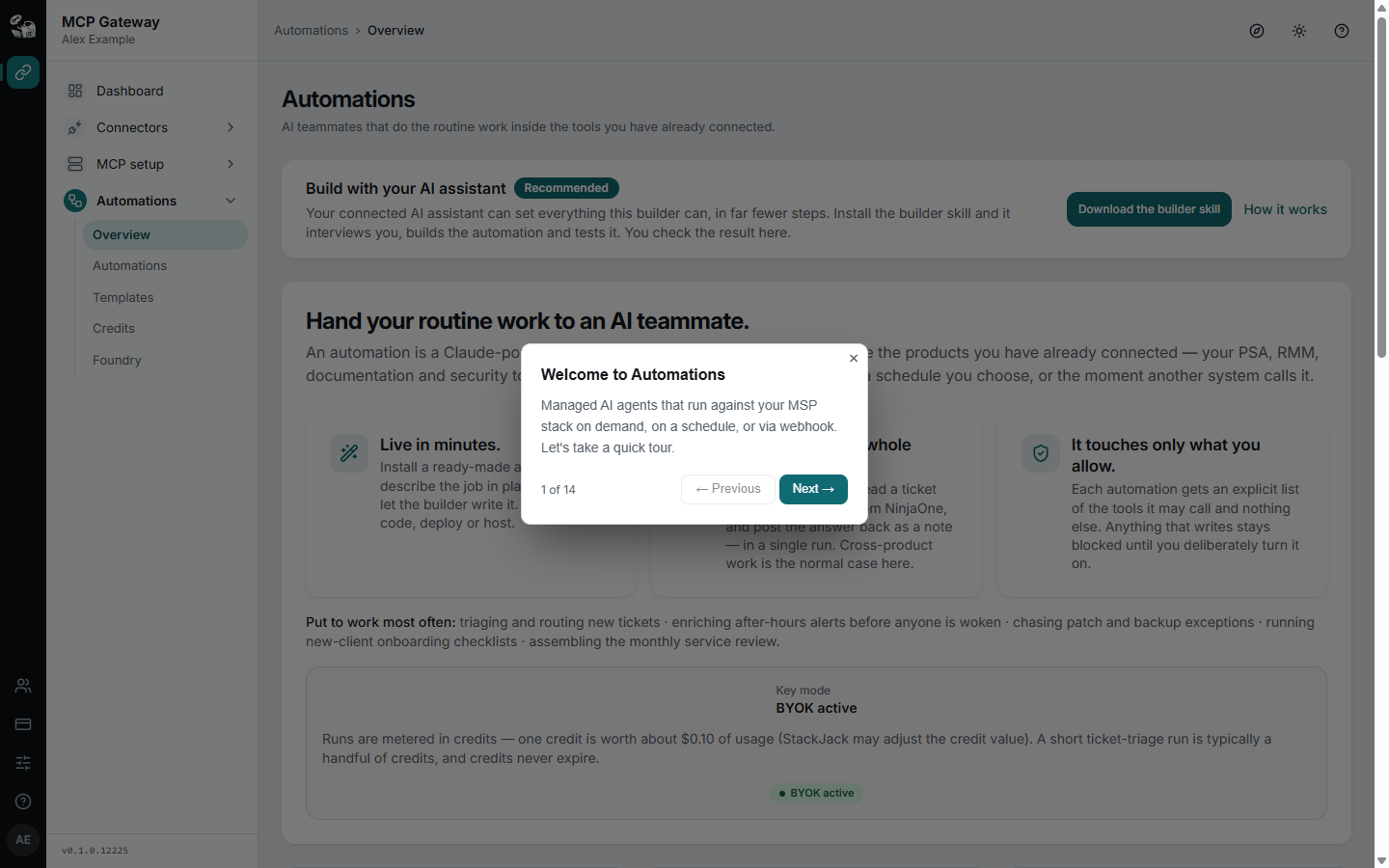
The first time you open the page, you land on Overview and a short guided tour starts: it walks through the sections listed under Automations in the menu, the Overview primer, the Automations list and its filters, the template gallery, and the Credits section. Steps that do not apply yet (for example, list filters when you have no automations) are skipped, and so are the steps that point at the menu while the menu column is hidden. To replay it later, select the compass button in the top bar (its label is Take a tour of this page). On later visits the page opens straight to the Automations section.
Overview
Overview is the landing page for the whole feature, which is why it is the first section. It reads top to bottom in four parts:
- A hero card summarizes the value of automations and shows your credit balance. A Buy credits button jumps to the Credits section — unless your tenant uses BYOK (your own Anthropic key), in which case a "BYOK active" badge appears instead.
- A status strip shows where you currently stand: how many automations you have (and how many of those are switched on), how many run unattended (scheduled or webhook-triggered), and your credit balance. If the balance cannot be read just now, the tile says so rather than showing a zero.
- Pick a starting point is the call to action: the three ways to build an automation — install a template, describe the job in plain English, or build it yourself — each with its own button. Once you have at least one automation this card becomes Build another one and adds a shortcut into your list.
- How automations work is the reference card, with five panels: what you are actually setting up, when it runs, what it costs, what keeps it safe, and where the results land.
Automations
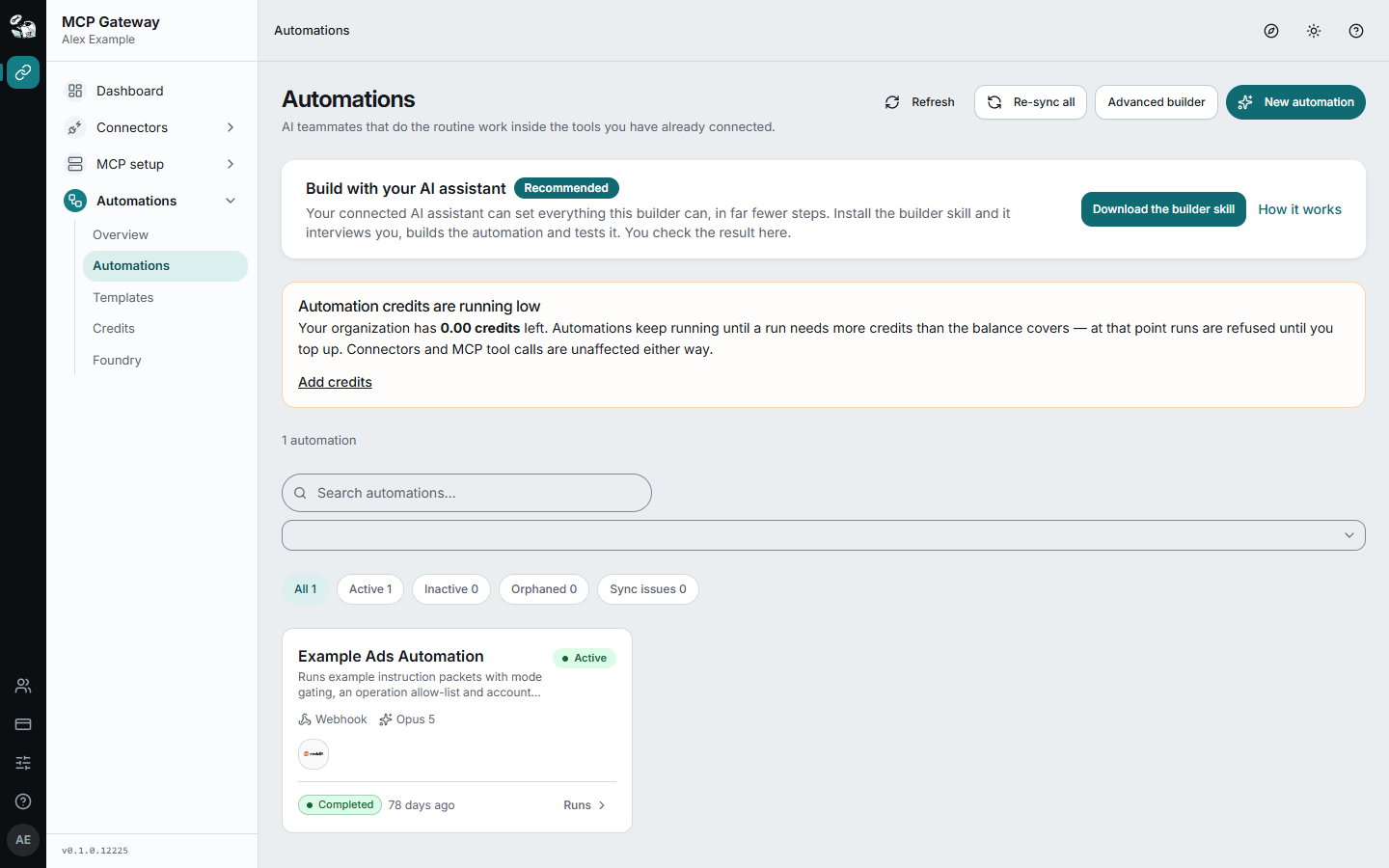
This is your working list.
When you have no automations yet
You see a "Build your first automation" state with two mode cards and a template link:
- Guided conversation — chat with an AI wizard that asks clarifying questions until your automation is ready. Opens the guided wizard.
- Advanced builder — a five-section builder with explicit tool policy, knowledge sources, and a live test panel. Opens the advanced builder.
- Browse templates — switches to the Templates section. See Using Automation Templates.
When you have automations
Once you have at least one automation, the two build-mode cards give way to an operational list: a count line, a search-and-sort row, the filter chips, and your automation cards.
Header buttons. The four actions sit in the page header, beside the page title, only while this section is open and you have automations. The count line under the title says how many you have (for example, "3 automations"). The four actions are:
- Refresh — re-loads the list and each card's latest run.
- Re-sync all — re-syncs every provisioned automation, one at a time (see Re-sync all below).
- Advanced builder — opens the advanced builder for a new automation.
- New automation — opens the guided wizard.
Search and sort. A search box filters the grid by name or description as you type. A Sort dropdown orders the cards by Last run (most recently run first — the default), Name, or Newest (most recently created first).
Filters. Chips with live counts let you narrow the grid: All, Active, Inactive, Orphaned, and Sync issues. "Sync issues" collects every automation that needs attention to stay in sync (sync needed, schedule drift, or orphaned). If your search and filters match nothing, the grid is replaced with a "No automations match" message and a Clear search & filters button.
Automation cards. Each card leads with the operational picture: the automation's name and description, an Active / Inactive health pill, and — when something needs attention — one or more warning pills. Below that sit the trigger type and Claude model, and a footer showing the last run (its status badge and how long ago it ran, or "No runs yet") with a Runs shortcut straight to the run history.
Click any card (or press Enter/Space with the card focused) to open that automation's detail page.
If the list fails to load, an error banner explains why (for example, the automation service being unreachable) with a Try again button.
Re-sync all
Re-sync all does what Re-sync agent on an automation's detail page does, for every provisioned automation of your organization: it pushes each configuration to Anthropic again and refreshes its credentials, and rebuilds an automation whose Anthropic agent no longer exists. Use it after your organization's own Anthropic key changed.
- Click Re-sync all. The dialog checks your automations and says how many it will re-sync, which ones it skips and why (a draft that was never provisioned, an orphaned automation, or one whose provisioning is still running), and which ones are over the limit for one request.
- Click Re-sync N automations. The automations are re-synced one at a time, so the request can take up to 3 minutes; keep the page open.
- The dialog then shows the result: how many were re-synced, each one that failed with the reason, each one that was skipped, and each one that was not attempted.
One request re-syncs at most 20 automations. If you have more, click Re-sync all again when the first request finishes: the next request skips the automations the earlier ones already re-synced (they are listed as skipped, "Already re-synced") and continues with the rest, so the series finishes. After your own Anthropic key changed, only an automation re-synced since the change counts as already re-synced. When nothing is left to re-sync (for example, you re-synced the last ones one at a time on their own pages), the dialog says so and offers Finish: it re-syncs nothing and records that Re-sync all is done, which takes away the alert above. If a refusal applies to every automation (for example, you are not allowed to configure automations, or your own Anthropic key cannot be used), the request stops there and lists the rest as not attempted. Only one Re-sync all of your organization runs at a time.
Your AI assistant can do the same with stackjack_set_agent_lifecycle and the action resync_all; to continue a series, it passes back the seriesStartedAt the previous answer gave.
Templates
The gallery of installable automation templates, with category filters and risk badges. Covered in full in Using Automation Templates.
Credits
The section leads with a Concurrency card, above the balance: three tiles — Concurrency slots (how many runs your organization may have going at once, captioned with where that number came from), In use now, and Waiting for a slot — plus a line giving your average and peak concurrency over the last 30 days. Full detail in Concurrency, Slots, and the Run Queue.
Below it: your credit balance, credit pack purchases, BYOK key management (for eligible accounts), and recent transactions. Covered in Credits and BYOK.
Foundry
Connect your organization's own Azure subscription (Azure AI Foundry) so an automation can run its model calls on Claude or another model there, billed by Azure, with no StackJack credits for the model usage. Set up on your subscription or paste a key, check each deployment's health, and remove the connection. Full detail in Running automations on your Azure Foundry.
Was this helpful?
Still need help? Ask the team