Connect Syncro
Syncro is a combined PSA + RMM + POS platform for MSPs — tickets, customers, invoices, assets, RMM alerts, products, and more. Connecting Syncro to StackJack lets your AI assistant work with all of it…
Written By Christopher Scaminaci
Last updated 6 days ago
Syncro is a combined PSA + RMM + POS platform for MSPs — tickets, customers, invoices, assets, RMM alerts, products, and more. Connecting Syncro to StackJack lets your AI assistant work with all of it through MCP tools (MCP is the Model Context Protocol, the open standard AI assistants use to call external tools).
Once connected, your AI can manage tickets, customers and contacts, invoices and estimates, contracts, products and inventory, purchase orders, customer assets, RMM alerts, appointments, leads, and wiki pages through tools with the syncro_ prefix (for example syncro_list_tickets). See the generated Syncro tool reference for the current inventory, input schemas, plan tiers, and safety notes.
Before you begin
You'll need:
- A StackJack role that can manage connectors: Owner, co-owner, or Administrator.
- A Syncro login with permission to manage API tokens.
- Your Syncro subdomain URL (for example
https://your-subdomain.syncromsp.com— it's in your browser address bar after you log in to Syncro).
The same steps below are also shown inside the portal — open Connectors, find the Syncro card, and click How To Connect.
Step 1 — Create an API token in Syncro
- Log in to Syncro as a user with API token management permission.
- Open your user menu, select Profile/Password, then select API Tokens.
- Click New Token, give it a descriptive name (for example, "StackJack Integration"), choose an expiration that matches your credential-rotation policy, and choose Custom Permissions — not a pre-built native-integration role.
- Check the permission box for each domain StackJack should access (Customers, Tickets, Invoices, Assets, RMM Alerts, Products, and so on). Any domain you leave unchecked will cause 401/403 errors on the matching tools later.
- Save, then copy the token immediately. Syncro shows the token exactly once — lost tokens must be regenerated.
Step 2 — Connect in StackJack
- In the StackJack portal, open Connectors from the sidebar.
- Find the Syncro card and click Configure (or How To Connect first if you want the in-portal walkthrough).
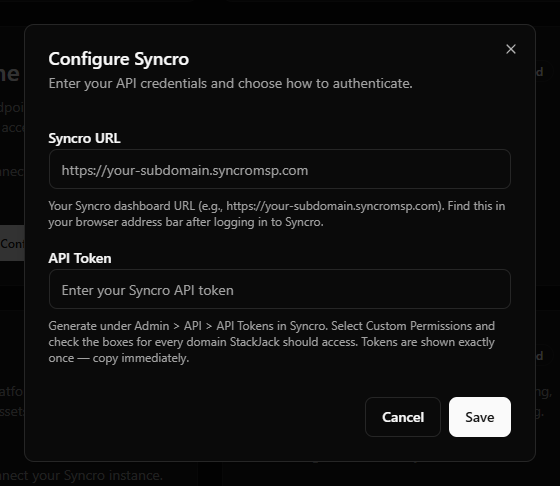
- Fill in the form:
- Click Save.
What happens when you save
- Your API token is stored encrypted in a secure vault — it is never stored in StackJack's database and never shown again in the portal.
- A Free plan for Syncro is activated automatically, so your AI can start calling Syncro tools right away.
- StackJack immediately runs a live validation call against Syncro. If validation fails, your credentials are still saved — fix the underlying issue (wrong URL, missing permission, revoked token) and click Re-test on the card.
Permissions your token grants
Syncro tokens use granular custom permissions — every tool call runs with exactly the permissions enabled on that token. You can modify an existing token's name, expiration, and permissions from Profile/Password > API Tokens. Syncro never redisplays the full token value, so replacing a lost value still requires a new token. A few endpoints (Appointment Types, Portal Users, and the global Line Items list) additionally require the token to belong to a Global Admin user.
The Syncro tool family spans these areas:
To see exactly which tools use which permissions — and to scope an AI client to a smaller tool set — open Permissions in the portal and select Syncro.
Plans, tools, and usage limits
- The Syncro tool family is split across plan tiers: the Free plan includes the core read/browse tools, and the Pro plan unlocks the larger write/management surface. Upgrade from the Syncro card on the Connectors page — current pricing is shown in the portal and at checkout.
- Each plan includes a monthly tool-call allowance; the usage bar on the connector card tracks it through your billing cycle. StackJack applies no per-minute rate limit of its own — the monthly allowance is the only StackJack-side cap.
- Syncro's API allows 180 requests per minute per IP address. StackJack paces its own Syncro requests towards that budget, and when Syncro returns a 429 (too many requests) it retries with exponential backoff and honours Syncro's Retry-After header; if retries are exhausted, it remembers the hit so later tool calls wait before contacting Syncro again. The limit is per IP address rather than per tenant, so pacing cannot guarantee you stay under it — anything else calling Syncro from the same address counts too. Narrow a wide read, and check whether a write landed before repeating it — see Retrying a failed or timed-out write.
Troubleshooting
Disconnecting
On the Syncro card, click Disconnect and confirm. This deletes your stored credentials and stops all Syncro tool calls.
⚠ Disconnecting does not cancel a paid Syncro plan — billing continues until you cancel it separately. The plan controls only appear while the connector is connected, so end the plan before disconnecting. On a paid connector that button reads Manage on Billing and opens this connector's removal dialog on the Billing page; a legacy website subscription still reads Cancel Plan. If you've already disconnected, save your credentials again to bring the plan controls back, then end the plan.
Syncro tools
syncro_ · 169 tools · Free 70 · Pro 99
Customers
Contacts
Customer Phones
Payment Profiles
Tickets
Ticket Timers
Worksheet Results
Invoices
Estimates
Payments
Contracts
Recurring Invoices
Products
Product Serials
Product SKUs
Purchase Orders
Vendors
Customer Assets
RMM Alerts
Appointments
Appointment Types
Leads
New Ticket Forms
Wiki Pages
Canned Responses
Users
Portal Users
User Devices
Timelogs
System & Search
Still need help? Ask the team